Saturday, January 22, 2011 - Bosque Birdwatchers RV Park, San Antonio NM
< previous day | archives | next day >
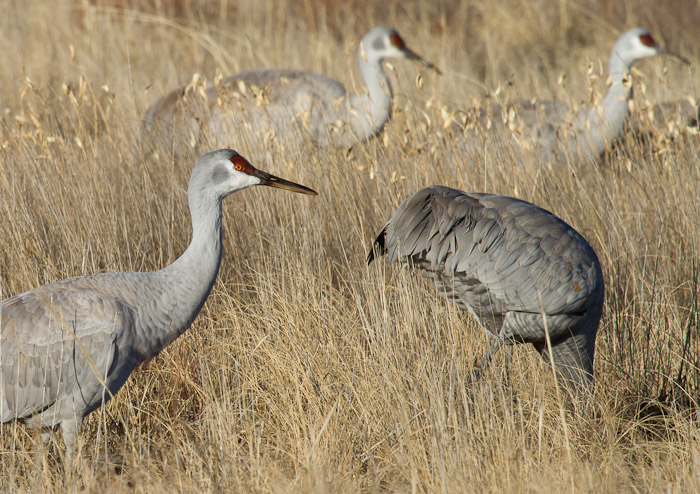
Foraging, Sandhill Cranes, Bosque del Apache National Wildlife Refuge, San Antonio NM, January 17, 2011
What do cranes eat anyway?
From what I can see, here they seem to be eating corn, which is grown for them, and the tubers of marsh grasses. You can't see it but this grassy meadow is flooded with a couple of inches of water. This area extends "upstream" from the shallow pond where the cranes roost. Pumps are running, pumping water into the upper end of this long meadow whence it flows slowly down through the grasses to the pond. Makes for good foraging and photographing.
Sandhill Cranes forage by picking and probing with their long bills both at and below the water’s surface, as well as on land. They prefer grain when available, but eat a wide variety of foods. In their northern breeding areas, they consume berries, mammals, and insects. Where resident year-round, Sandhill Cranes eat insects, reptiles, amphibians, small birds and mammals, seeds, and berries. Source: Cornell Laboratory of Ornithology.
Night camp
Site 10 - Bosque Bird Watcher's RV Park, San Antonio NM
- This is a basic, small Mom & Pop RV Park with full hookups.
- Verizon cell phone and Broadband service are available here with a strong signal.
- Locate Bosque Bird Watcher's RV Park on my Night Camps map
- Click for Google street view
- Check the weather in San Antonio NM
Sweet, Rich Hickory Milk
Hickory was another favorite. Rambling through the Southeast in the 1770s, the naturalist William Bartram observed Creek families storing a hundred bushels of hickory nuts at a time. "They pound them to pieces, and then cast them into boiling water, which, after passing through fine strainers, preserves the most oily part of the liquid" to make a thick milk, "as sweet as fresh cream, an ingredient in most of their cookery, especially hominy and corncakes." Years ago a friend and I were served hickory milk in rural Georgia by an eccentric backwoods artist named St. EOM who claimed Creek descent. Despite the unsanitary presentation, the milk was ambrosial - fragrantly nutty, delightfully heavy on the tongue, unlike anything I had encountered before.