Friday, May 7, 2010 - Crossroads RV Park, Lyndon KS
< previous day | archives | next day >
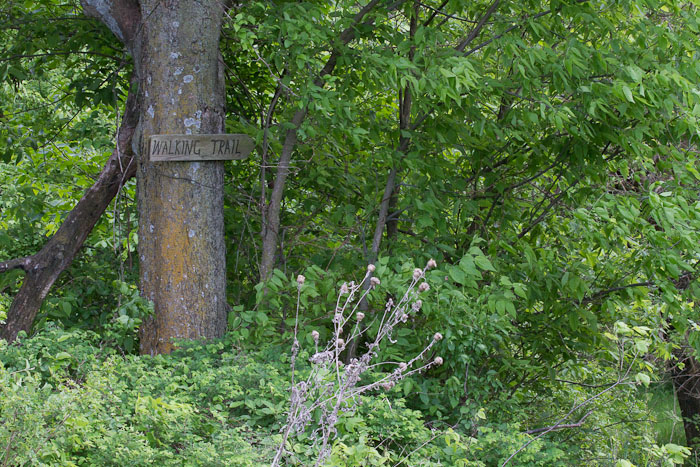
Walking Trail, Crossroads RV Park, Lyndon KS, May 6, 2010
I'm taking a break
I'm going to stay here the weekend and see if I can't get caught up on some website maintenance I've been having a hard time finding a big enough block of time so I can concentrate on it. This is a nice quiet park with a mile or so of hiking trail and should work just fine for the purpose.
Besides, I need to slow down a little - I'm way ahead of schedule on my trek east. Sometimes my planned stopping points don't work out. The park or Walmart I have figured for a night camp sometimes has the wrong vibe and I keep moving.
Passport America
I joined the Passport America discount camping program and have been staying at some of their member parks. This is one of them, probably the best I've found so far. My standards are pretty modest but I've come across a couple of older parks that gave me the willies. Passport America has some screening to catch up on.
Night camp
Site 28 - Crossroads RV Park & Campground, Lyndon KS
- Crossroads RV Park & Campground is a new 42 site park on US-75 about 2 miles north of Lyndon KS. It's nicely shaded and surrounded by farmland with a mile or so of hiking trails.
- Verizon cell phone and Broadband service are available here with a strong signal.
- Locate Crossroads RV Park & Campground on my Night Camps map
- Check the weather here
Walk Humbly
The longer I live, the more I read, the more patiently I think, and the more anxiously I inquire, the less I seem to know.... Do Justly. Love mercy. Walk humbly. This is enough....
John Adams, in a letter to his granddaughter Caroline