May 07, 2008 - I'm back home in Red Rock
< previous day | archives | next day >
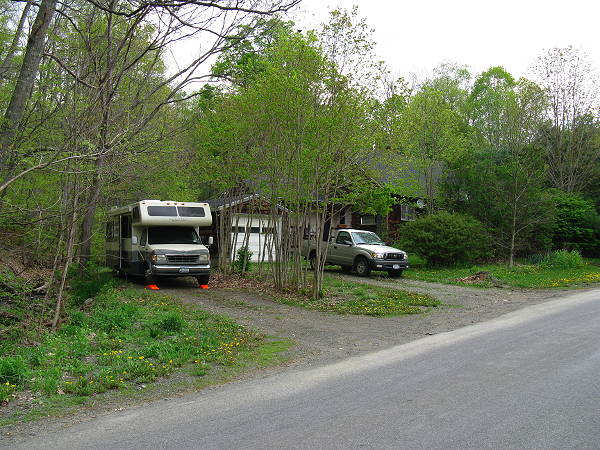
Parked in the lower driveway for the summer, May 8, 2008
LD and I pass the test
LD, this old Lazy Daze RV, and I passed the test with flying colors - the test to see if my twenty year old dream of traveling full time about the country via RV has legs.
It has legs alright - strong, sturdy legs.
It's been a great trip. This old Lazy Daze has proven to be a comfortable place to live and has taken me to many new places and introduced me to some wonderful new friends this past winter that I want get to know better. I can hardly wait to get back out there again next fall to continue the adventure. Balloon Fiesta here we come!
Night camp
At home in Red Rock (near Chatham in Columbia County, New York)
Teosinte and the Improbability of Maize
The ancestors of wheat, rice, millet, and barley look like their domesticated descendants; because they are both edible and highly productive, one can easily imagine how the idea of planting them for food came up. Maize can't reproduce itself, because its kernals are securely wrapped in the husk, so Indians must have developed it from some other species. But there are no wild species that resemble maize. Its closest genetic relative is a mountain grass called teosinte that looks strikingly different - for one thing, it "ears" are smaller than baby corn served in Chinese restaurants. No one eats teosinte, because it produces too little grain to be worth harvesting. In creating modern maize from this unpromising plant, Indians performed a feat so improbable that archaeologists and biologists have argued for decades over how it was achieved. Coupled with squash, beans, and avocados, maize provided Mesoamerica with a balanced diet, one arguably more nutritious than its Middle Eastern or Asian equivalent.