Primitive Campground at Fort Stanton Cave, Lincoln NM
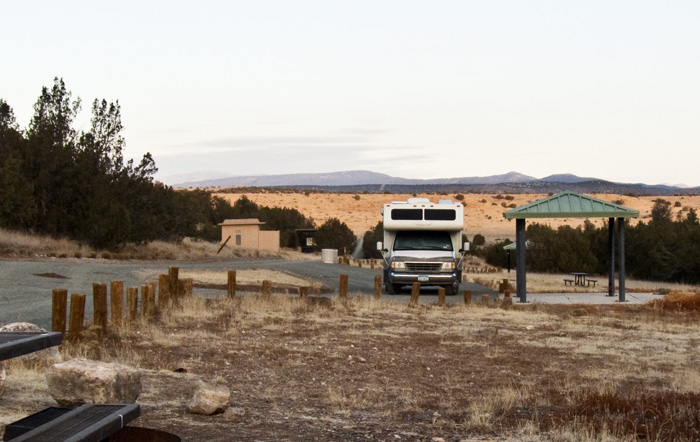
Dawn at Fort Stanton Cave, December 19, 2009
This little, 3 site, primitive campground is at the entrance to the Fort Stanton Cave in the new Fort Stanton-Snowy River Cave National Conservation Area off US 380 west of Lincoln NM. This Conservation Area was established in 2009 to protect and conserve the unique and nationally important subterranean cave resources of the Fort Stanton - Snowy River cave system. Snowy River is a significant passage within Fort Stanton Cave. This campground primarily serves those who have been issued a permit to enter the cave.
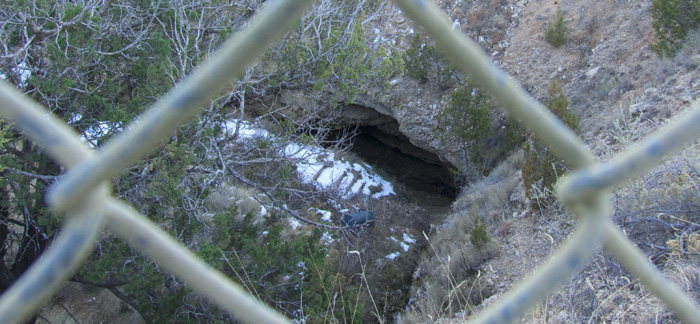
Fort Stanton Cave entrance, December 18, 2009
With 14-3/4 miles of mapped passages, Fort Stanton Cave is the third largest cave in New Mexico. The cave is open for recreational caving under permit from April 15 to November 1.
Snowy River Passage in Fort Stanton Cave
To quote the Bureau of Land Management
Very slow moving ground water dissolved the grayish-brown limestone in which the cave is formed and recrystallized that limestone into a white-colored mineral called calcite. Through numerous infillings of ground water saturated with calcite, followed by draining and drying, repeated coats of calcite were laid on the bottom of the cave through the entire five miles of Snowy River passage that has been surveyed to date. This unique white crystalline deposit glistens like snow and may be the largest calcite formation in America. Several endemic microorganisms have been discovered in this new section of the cave. In this sunless environment, species living here do not get their energy from the sun. Instead, they chemically break down rock. In the process, they create chemical byproducts that could have pharmaceutical uses. There are also several species that have formed symbiotic relationships with each other.
Continuing exploration and scientific research will help us better understand the formation of caves in this area, improve our understanding of groundwater hydrology of the region, and increase our knowledge of the biology of the cave. In the years to come, many new biological discoveries are anticipated.
Due to the scientific importance of the cave, the Snowy River passage is not open to the public. BLM is planning interpretive products in the future so the public can enjoy and better understand this unique resource.
Read Snowy River Passage for more info.
Primitive Campground at Fort Stanton Cave, Lincoln NM
- This is a primitive campground with three sites and a single pit toilet.
- Verizon cell phone and Broadband service is good.
- Fort Stanton-Snowy River Cave National Conservation Area info
- Locate Fort Stanton Cave Campground on my Night Camps map
- Check the weather here
Nights I've camped here
Wind on the Gangplank
There was almost no soil in that part of the range - just twelve miles' breadth of rough pink rock. "As you go from Chicago west, soil diminishes in thickness and fertility, and when you get to the gangplank and up here on top of the Laramie Range there is virtually none," Love said. "It's had ten million years to develop, and there's none. Why? Wind - that's why. The wind blows away everything smaller than gravel."
Standing in that wind was like standing in river rapids. It was a wind embellished with gusts, but, over all, it was primordially steady: a consistent southwest wind, which had been blowing that way not just through human history but in every age since the creation of the mountains - a record written clearly in wind - scored rock. Trees were widely scattered up there and, where they existed, appeared to be rooted in the rock itself. Their crowns looked like umbrellas that had been turned inside out and were streaming off the trunks downwind. "Wind erosion has tremendous significance in this part of the Rocky Mountain region," Love said, "Even down in Laramie, the trees are tilted. Old-timers used to say that a Wyoming wind gauge was an anvil on a length of chain. When the land was surveyed, the surveyors couldn't keep their tripods steady. They had to work by night or near sunrise. People went insane because of the wind." His mother, in her 1905 journal, said that Old Hanley, passing by the Twin Creek school, would disrupt lessons by making some excuse to step inside and light his pipe. She also described a man who was evidently losing to the wind his struggle to build a cabin: