Thursday, March 31, 2011 - Harrah's Convenience Store, Laughlin NV
< previous day | archives | next day >
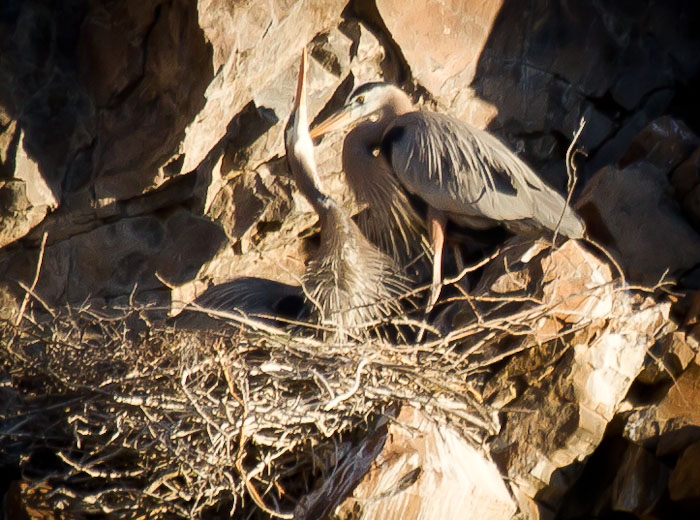
Oooooh... It Feels Good to Stretch!, Great Blue Herons, Burro Creek AZ, March 28, 2011
Bah!
On discovering these herons nesting on the cliff across the creek from Burro Creek Campground late Saturday afternoon I took literally a thousand pictures that afternoon and early the next morning only to discover every single one of them was at least slightly blurry. Some were worse than others but none were as crisp as I expected with my camera mounted on my firmly planted tripod. It took quite a while for me to figure this one out - I forgot to turn off the camera's image stabilization system. It gets confused by the stability of the tripod and shakes the camera trying to figure out what's happening. Bah!
Night camp
Site 17 - Harrah's Convenience Store RV Parking, Laughlin NV
- Good Verizon cell phone and Broadband service are available here.
- Locate Harrah's Laughlin Convenience Store on my Night Camps map
- Check the weather here
Teosinte and the Improbability of Maize
The ancestors of wheat, rice, millet, and barley look like their domesticated descendants; because they are both edible and highly productive, one can easily imagine how the idea of planting them for food came up. Maize can't reproduce itself, because its kernals are securely wrapped in the husk, so Indians must have developed it from some other species. But there are no wild species that resemble maize. Its closest genetic relative is a mountain grass called teosinte that looks strikingly different - for one thing, it "ears" are smaller than baby corn served in Chinese restaurants. No one eats teosinte, because it produces too little grain to be worth harvesting. In creating modern maize from this unpromising plant, Indians performed a feat so improbable that archaeologists and biologists have argued for decades over how it was achieved. Coupled with squash, beans, and avocados, maize provided Mesoamerica with a balanced diet, one arguably more nutritious than its Middle Eastern or Asian equivalent.