Tuesday, March 17, 2009 - City of Rocks State Park, Faywood NM
< previous day | archives | next day >
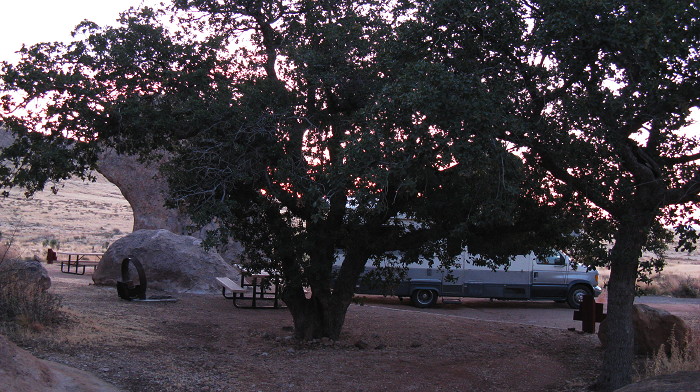
Emory oaks at dawn, Site 12, City of Rocks State Park, Faywood NM, March 14, 2009
Emory oak
Here's what Wikipedia has to say about the Emory oak:
Emory oak (Quercus emoryi) is a species of oak common in Arizona, New Mexico and western Texas (Big Bend National Park), USA, and northern Mexico south to Durango and San Luis Potosí. It typically grows in dry hills at moderate altitudes.
It is a live oak in the red oak group, retaining its leaves through the winter until the new leaves are produced in spring, and is a large shrub or small tree from 5-17 m tall. The leaves are 3-6 cm long, entire or wavy-toothed, leathery, dark green above, paler below. The acorns are 1.5-2 cm long, blackish-brown, and mature in 6-8 months from pollination; the kernel is sweet, and is an important food for many mammals and birds.
The tree is named after the United States army surveyor, Lieutenant William Hemsley Emory, who surveyed the area of west Texas where it was discovered in 1846.
Night camp
Site 12 - City of Rocks State Park, Faywood NM
- Verizon cell phone service - fairly good signal - best on west side of the park
- Verizon EVDO service - faster than many places I've camped
- Go to City of Rocks State Park website
- Locate City of Rocks State Park on my Night Camps map
- Check the weather here
Karl Blossfeldt Plant Studies

Karl Blossfeldt (1865-1932) was a German instructor of sculpture who used his remarkable photographs of plant studies to educate his students about design in nature. Self-taught in photography, he devoted himself to the study of nature, photographing nothing but plants for thirty-five years.