My 1969 Airstream Tradewind Camper
Propane, or LP-gas as it is known in the industry, is widely used in the recreational vehicle world. I've gathered here some basic information about propane how to use it safely.
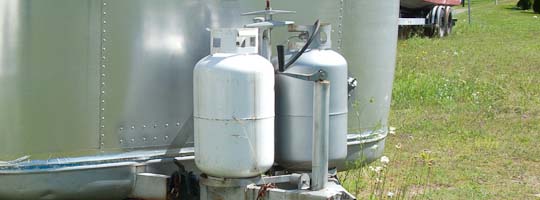
| Nominal Size | Gallon Capacity | BTU Capacity |
| 10# | 2.36 | 215,807 |
| 20# | 4.72 | 431,613 |
| 30# | 7.08 | 647,420 |
| 40# | 9.43 | 863,226 |
The above capacities allow for the 20% vapor space that is left in a full cylinder.
To estimate roughly how long your propane gas supply will last, divide the storage capacity of your supply tank or cylinder(s) in BTU by the gas consumption of your appliance(s). An appliance's rated consumption should be in its manual or on its nameplate.
| Pounds per gallon | 4.24 |
| Specific gravity of gas | 1.50 |
| Specific gravity of liquid | 0.504 |
| Cu. ft. gas per gallon liquid | 36.38 |
| Cu. ft. gas per pound | 8.66 |
| BTU per gallon | 91,502 |
| BTU per pound | 21,548 |
| Boiling point in deg F at 14.7 psia | -44 |
| Vapor pressure at 0 deg F | 31 |
| Vapor pressure at 70 deg F | 127 |
| Vapor pressure at 100 deg F | 196 |
| Vapor pressure at 115 deg F | 230 |
1 gallon = 3.785 liters
11 in. Water Column = 6-1/4 ozs. per sq. in. pressure
27.7 in. Water Column = 1 pound per sq. in. pressure
Here is a link to Manchester Tank's Helpful Hints page where I found these useful tables. Manchester Tank is a leading manufacturer of Propane Cylinders and Tanks used in the RV industry.
Approved and properly adjusted appliances are very important. Improper flame adjustment (which you can detect by a yellow flame at the burner tip) is dangerous. With adequate ventilation, an operating burner gives off mostly harmless products such as carbon dioxide and water vapor. However, a propane appliance starved of oxygen can quickly produce dangerous amounts of carbon monoxide and may result in asphyxiation. When operating your oven and/or range, open a vent and window to insure an adequate supply of air for safe operation. Never use the oven for heating the recreational vehicle.
Carbon monoxide is a colorless and odorless gas, and can't be detected through your sense of smell. If you are exposed to carbon monoxide, you may experience any or all of these symptoms:
NOTE: If any of these symptoms should develop, get into the fresh air immediately, and have your propane system checked and repaired as needed.
When produced, propane is both colorless and odorless. For safety reasons, a chemical odorant is added so that, in the event of a leak, you can detect the escaping gas by its strong, distinct smell. Become familiar with it's odor.
Under certain circumstances, propane gas may lose the distinctive odor that was added. This is sometimes called “odor fade,” and it can occur both in new steel containers when first placed into service and in used steel containers left open to the atmosphere for a long time. In addition, under certain circumstances not everyone can smell the odorant in propane. Physical conditions such as competing odors, commons colds and allergies, smoking, etc. may lessen a person's ability to smell.
If you think the odor of your propane gas is weak, or if your sense of smell is impaired, call your propane supplier. A service technician can verify the odor of the propane gas in your tank. And if your sense of smell is impaired, consider installing an electronic gas detector in your RV.
The pressure of propane gas in a system reacts to temperature changes, rising and falling with temperature. A pressure regulator is needed to maintain a constant delivery pressure to your gas appliances at all times.
National code requires a two-stage regulator on RVs. The second stage of the regulator receives a relatively uniform pressure from the first stage, which helps the second stage maintain appliance pressure at a nearly constant 11" W.C. Also, a two stage regulator greatly reduces the possibility of freeze-ups.
The propane regulator is the heart of the propane system. Take care to protect it from the elements which could cause it to malfunction. Regulators need to be installed and protected so as to prevent the vent's clogging due to rain, snow, sleet, ice, condensation or road spray. To prevent the regulator from being exposed to these conditions, special shielding protection must be provided.
CAUTION - ALWAYS BE SURE THAT THE REGULATOR VENT IS POINTING DOWN WITHIN 45 DEGREES OF VERTICAL.
A blocked regulator vent could result in excessive gas pressure to appliances, or regulator failure, which could result in injury or property damage.
NOTE: Do not attempt to repair a regulator – call your propane gas dealer if service is required.
The propane system should be kept free of moisture which could cause regulator freeze-up. A good regulator enclosure will protect your regulator.
Moisture in the fuel can cause the regulator to freeze up. When storing portable cylinders, keep the cylinder valve closed and POL plug in place to help keep moisture out of the tank. If you suspect the presence of moisture, have your propane dealer inject methyl alcohol into your cylinder or tank before refilling.
Propane, is sold and stored in containers that, when properly filled, contain about 80 percent liquid. The remaining 20 percent of space above the liquid contains propane vapor. It is this vapor that burns in your appliance when mixed with air.
The vapor space in the propane cylinder also provides room for the liquid propane to expand if the cylinder is exposed to warmer temperatures.
Never allow your propane cylinder or tank to be filled above the maximum safe level as indicated by a OPD, a scale or the fixed liquid level gauge. Do not use the visible gauge for filling.
If a cylinder is overfilled beyond 80 percent capacity there won't be enough vapor space to accommodate the expanding liquid if the cylinder is exposed to warmer temperatures. The pressure relief valve may open, discharging propane to relieve the pressure. Liquid propane could enter the piping system, resulting in higher than normal pressures to the appliances. If the cylinder becomes liquid full and the pressure relief valve fails to open, the container could rupture, resulting in serious injury or property damage.
Propane tanks for permanent installation are built to ASME Boiler and Pressure Vessel Code and their capacity is expressed in U. S. Gallons.
Propane cylinders for transportable use are built to DOT Hazardous Materials Regulations and their capacity is expressed in pounds of water.
CAUTION: USE PROPANE CYLINDERS AND TANKS IN PROPER POSITION
There are two basic types of portable propane cylinders – the vertical (upright) standard cylinder and the horizontal cylinder that comes with a special mounting bracket and which can be installed either vertically or horizontally. Both cylinders are manufactured in accordance with U.S. Department of Transportation (DOT) specifications.
When you purchase a new cylinder, be sure it fits the bracket you have. And if you use a cylinder exchange service, be sure the cylinder you receive is the same type as you turned in. Vertical cylinders are NOT designed for service while lying on their sides.
Propane appliances for cooking, heating, lighting, water heating and refrigeration are designed to operate on gas vapor only. Therefore cylinders and tanks designed for vapor service must be transported, installed and used in the proper position. Do not transport, install or use a vertical cylinder in a horizontal or upside down position. Proper care must be taken to position a horizontal container in the correct position for vapor withdrawal. Liquid propane could enter the system designed for vapor only, possibly creating a hazardous condition.
Federal DOT (Department of Transportation) regulations require periodic inspections and re-qualifications of cylinders. DO NOT USE damaged or rusted containers.
Filling a DOT propane gas cylinder that has not been properly inspected and qualified violates federal law.
Propane gas containers and regulators must be installed and properly secured in or on your vehicle so as to minimize damage in the event of a collision or accident.
On travel trailers and tent trailers propane cylinders are usually mounted on the A frame as close to the front of the trailer body as possible.
On motor homes, vans, fifth wheel trailers or slide-in chassis-mounted units propane cylinders or tanks are usually mounted in a recessed compartment accessible only from and ventilated to the outdoors and gas tight to the interior of the vehicle. Pressure relief valves must be pointed away from the vehicle or toward the container compartment opening.
Because propane vapors are heavier than air, the compartments for all propane containers aboard your vehicle must be ventilated, both at the top and bottom, and completely sealed from the interior of your vehicle.
Propane gas cylinders should not be mounted on the roof or front of a vehicle.
NOTE: If your vehicle is involved in a collision or other accident, shut the gas supply off at the container and have the system checked by a qualified propane service person.
Propane is normally non-corrosive - you need not worry about the inside of your container. However, the outside should be kept free from rust by a periodic coat of paint in a light reflective color. It is very important to inspect and maintain the bottom and footring on the container. Aluminum cylinders do not require painting.
Always use a POL plug installed on a POL valve or a dust cap on an ACME/Type 1 valve when transporting or storing disconnected containers (full or empty). This will keep gas from escaping and prevent foreign material from entering the cylinder should the valve be opened accidentally.
Propane gas cylinders must be transported so the relief valve communicates with the vapor space at all times. For that reason, you should never transport a cylinder lying on its side unless it's a cylinder designed for horizontal use. Transport the container in the proper position in which it is used, with the valves closed and POL Plugs inserted for POL Valves, or Dust Caps for Acme Valves. Secure the tank against falling or rolling.
Never put full or empty cylinders in the passenger space or living area of your camper, RV or other vehicle.
Never store a cylinder inside a building, including a garage. Spare cylinders, for instance, should be stored outdoors and up off the ground on a non-combustible base.
Any cylinder that is damaged, shows signs of corrosion, has been exposed to fire, or appears to be leaking gas should be removed from service immediately. Store defective cylinders in a safe, outdoor location. Then as soon as possible, have them repaired or disposed of by a qualified service technician.
Do not attempt to repair any containers, container valves, regulator or appliances by yourself. Use only trained, certified service personnel to perform repairs.
Before entering a gasoline or propane refueling area, turn off all open flames, pilot lights, water heaters, furnaces, generators, and any appliances with automatic ignition devices. Turn the engine off. IT'S THE LAW.
It is essential to not only turn off all operating propane appliances but to switch off all appliances that might turn on automatically and generate a spark in the igniter.
Before permanently mounted propane tanks are refueled, all passengers should leave the vehicle as well.
Only qualified persons should fill your propane cylinders and tanks.
CAUTION: OVERFILLING IS HAZARDOUS! Do not allow your propane container to be overfilled.
Never allow your propane cylinder or tank to be filled above the maximum safe level as indicated by a OPD, a scale or the fixed liquid level gauge. Do not use the visible gauge for filling.
Stop filling when liquid appears at the fixed level gauge. Bleed off excess propane in a safe area. Most propane containers are equipped with a fixed liquid level gauge which contacts the liquid level at 80% of container capacity, allowing 20% for expansion. Cylinders not equipped with a fixed liquid level gauge can only be filled by weight.
Propane containers must not be filled over 80% of total capacity. Propane expands approximately 1.5% for each 10º F temperature rise. Pumps do not stop filling "automatically." Pumps "by-pass" when containers are dangerously filled to total capacity. If overfilled, excessive pressure could develop within the container causing the relief valve to open, relieving excess pressure. Gas released through the relief valve is flammable.
The fixed liquid level gauge is used only to determine safe fill levels and does not indicate lower levels. Propane containers are available with visible gauges that monitor the amount of gas in the container at all times, reading from full to empty. Do not use visible gauges for filling.
New cylinders or used cylinders that have been exposed to the atmosphere must be purged of air before being filled.
Air in propane containers is a contaminant. Purging is done prior to initial filling to remove the air. If the container is not properly purged, air in the container dilutes the gas vapor. Failure to purge may cause excessive tank pressure, slow filling and poor appliance operation. Appliances then require constant adjustment and pilot lights won't stay lit. This condition would exist until all air is depleted, leaving pure propane gas vapor.
Have your propane container properly purged. It only takes a few minutes and your propane dealer is equipped to perform this service (see NPGA bulletin 133-89A).
The purpose of this bulletin is to provide you with basic knowledge of LP-gas engine fuel and LP-gas carburetion.
The advantages of Liquefied Petroleum Gas (propane) as a fuel for internal combustion engines are well established. It is being used in ever increasing volume as a motive power for trucks, buses, automobiles, tractors and stationary engines.
What are the characteristics of LP-gas as an engine fuel? What precautions are necessary to take full advantage of this fuel?
This bulletin will answer the above questions and familiarize you with the proper care and handling of LP-gas as an engine fuel.
These are the principal functions performed in the conversion process:
Refueling an LP-gas powered vehicle must be done by trained personnel. Basic steps to follow are:
These common-sense rules should be observed: